




High Quality Two Holes Round Nuts Round End Turning Nuts with Drilled Holes in One Face
High Quality Two Holes Round Nuts Round End Turning Nuts with Drilled Holes in One Face
- Beschrijving
- Beoordelingen (0)
Beschrijving
What are Two Holes Round Nuts?
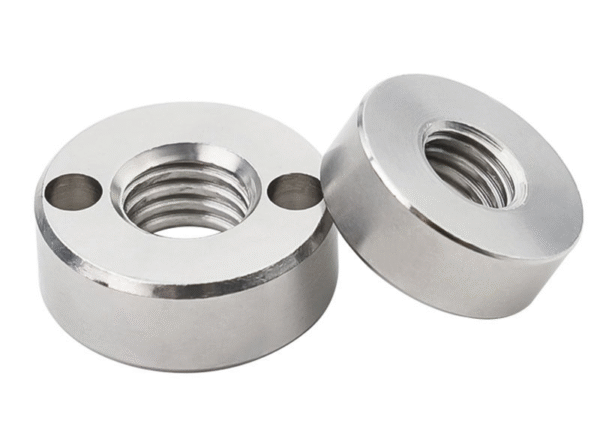
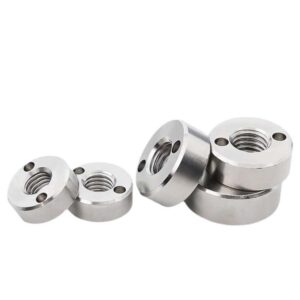
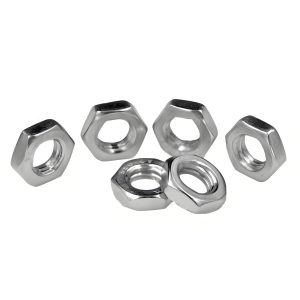
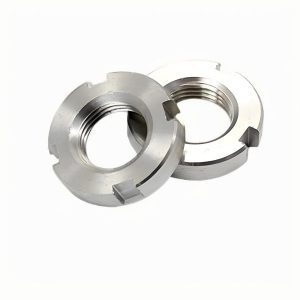
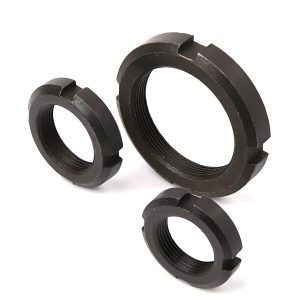
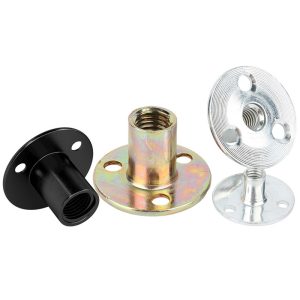
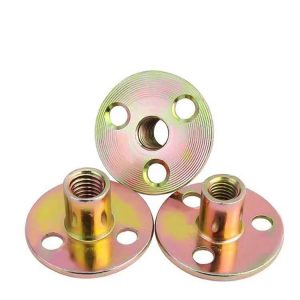
Two holes round nuts, also known as round nuts with drilled holes or spanner round nuts, are circular nuts featuring two small, radially opposite holes drilled through their sides or top face. These holes allow for engagement with a specialized pin spanner wrench (C-wrench or hook wrench), enabling application of torque in confined spaces or on smooth cylindrical surfaces where traditional hexagonal faces are impractical. They are primarily used for fine adjustment, locking, and securing components on threaded shafts, rods, or within housings.
Common Materials of Two Holes Round Nuts
Carbon Steel: The most common material, offering good strength and durability for general industrial use.
Stainless Steel: Provides excellent corrosion resistance for applications in harsh environments, food processing, marine, or chemical industries. Grades such as 304 and 316 are typical.
Brass: Used for its corrosion resistance, non-magnetic properties, and aesthetic appeal in decorative or electrical applications.
Aluminum: Chosen for lightweight applications where strength requirements are moderate and corrosion resistance is needed.
Alloy Steel: Often heat-treated (e.g., grade 8 or 10) for high-strength, high-stress applications.
Surface Treatments of Two Holes Round Nuts
Zinc Plating: The most common finish for carbon steel nuts, providing good corrosion resistance and a silvery appearance. Can be clear, yellow (chromate), or black.
Hot-Dip Galvanizing: A thicker zinc coating for superior corrosion protection in outdoor or severe environments.
Nickel Plating: Offers a hard, shiny, and corrosion-resistant finish, often used for aesthetic or moderate chemical exposure.
Black Oxide: Provides a black finish with mild corrosion resistance and reduces light glare. Popular in automotive and tooling.
Passivation: A chemical treatment for stainless steel to enhance its natural oxide layer and improve corrosion resistance.
Phosphating: A pre-treatment for painting or oil retention, offering mild corrosion resistance.
Plain/Oil Finished: No coating, often used for stainless steel or brass where the base material properties are sufficient.
Key Specifications of Two Holes Round Nuts
Thread Type & Size: Defined by thread standard (e.g., metric M6, M8, M10; imperial 1/4″-20, 3/8″-16) and thread pitch.
Major Diameter: The outer diameter of the nut.
Height/Thickness: The overall thickness of the nut.
Hole Diameter: The diameter of the two pin holes.
Hole Spacing (PCD): The Pitch Circle Diameter, the distance between the centers of the two holes.
Pin Hole Style: Can be radial (holes on the sidewall) or axial (holes on the top face).
Material Grade: Indicates mechanical properties (e.g., Grade 5, Grade 8 for steel; A2 or A4 for stainless steel).
Primary Application of Two Holes Round Nuts
Machine Tools: For adjusting and locking bearings, sleeves, and lead screws on lathes, mills, and grinders.
Automotive & Aerospace: Securing components on control linkages, throttle assemblies, and precision adjustment points.
Optics & Instrumentation: Fine adjustment and locking of lenses, mirrors, and sensitive mechanical components.
Printing & Packaging Machinery: Adjusting roller positions and tensioning systems.
General Fabrication & Fixturing: Used in jigs, fixtures, and any assembly requiring a low-profile, adjustable nut on a threaded rod.
Food & Beverage Equipment: Stainless steel versions are used in sanitary design assemblies.
Excellent Case: Precision Lathe Tailstock Adjustment
Challenge: On a high-precision engine lathe, the machinist needed to make minute, controlled adjustments to the tailstock quill’s lateral alignment (set-over) for cutting very shallow tapers. The standard hex nut on the adjustment screw was difficult to access with a wrench in the confined space and allowed for too coarse adjustment, risking over-tightening and misalignment.
Solution: The hex nut was replaced with a medium-carbon steel, black oxide-finished two holes round nut. This nut was threaded onto the existing tailstock adjustment screw. The machinist used a calibrated pin spanner that fit snugly into the two radial holes of the nut.
Outcome: The round nut’s low-profile design provided full wrench access. By applying gentle, measured torque with the pin spanner, the machinist could make extremely fine and repeatable adjustments to the tailstock alignment. The two-hole design prevented the wrench from slipping, eliminating the risk of damaging adjacent precision surfaces. This resulted in the consistent production of accurate tapers with a surface finish that met strict tolerances, improving part quality and reducing setup time for taper-turning operations.

Beoordelingen
Er zijn nog geen beoordelingen.