


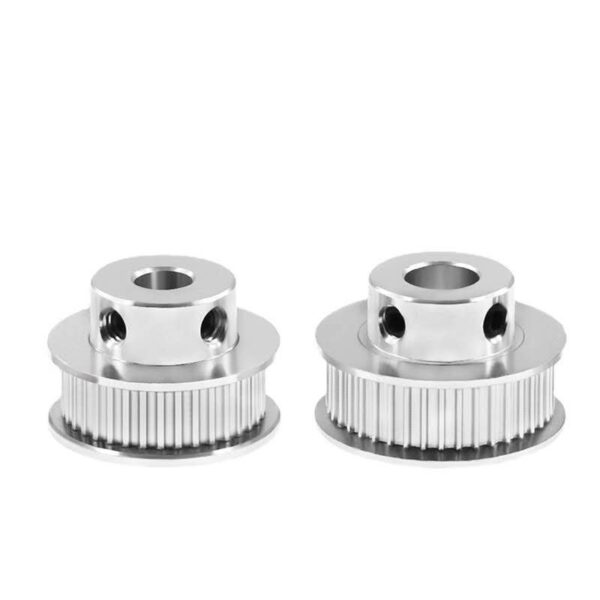
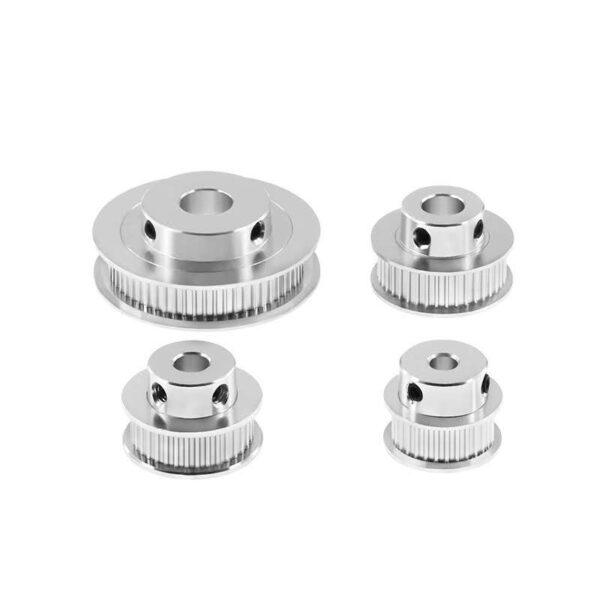
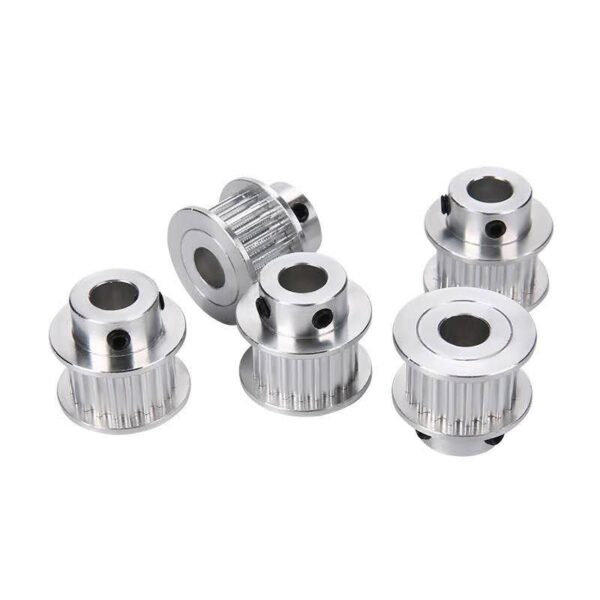
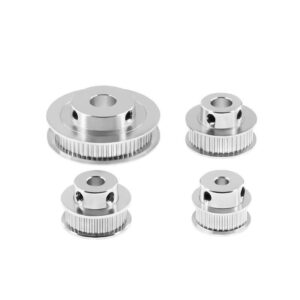
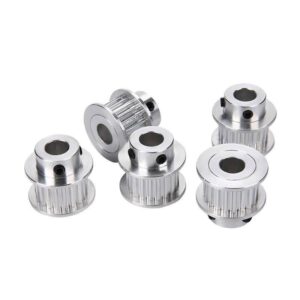
CNC Aluminum Reliable Timing Pulley 20 teeth 5mm bore for Machinery Transmission

CNC Aluminum Reliable Timing Pulley 20 teeth 5mm bore for Machinery Transmission
- Descrizione
- Recensioni (0)
Descrizione
What’s a Timing Pulley?
A timing pulley is a specialized pulley with precisely shaped teeth around its circumference, designed to mesh seamlessly with the teeth of a timing belt. This positive engagement prevents slippage, ensuring accurate and synchronous power transmission between shafts. It is a critical component in motion control systems where maintaining the exact positional relationship between input and output is essential.
Materials
Common materials used for timing pulleys include:
Aluminum: Widely used for its excellent strength-to-weight ratio, good corrosion resistance, and ease of machining. Ideal for most general industrial applications.
Steel (including Stainless Steel): Used for high-strength, high-durability, and high-temperature applications. Stainless steel offers superior corrosion resistance for harsh environments like food processing or chemical industries.
Plastics (e.g., Nylon, Polyacetal/Delrin): Chosen for applications requiring quiet operation, corrosion resistance, light weight, and where lubrication is not desired. Common in packaging, printing, and light-duty machinery.
Cast Iron: Occasionally used for very large pulleys in heavy industrial applications due to its high mass and damping properties.
Surface Treatments & Finishes
Surface treatments enhance performance and longevity:
Anodizing (for Aluminum): Increases surface hardness, wear resistance, and corrosion protection. Can also add color for part identification.
Black Oxide/Phosphate Coating (for Steel): Provides mild corrosion resistance, reduces light reflection, and improves aesthetics.
Hardening & Tempering (for Steel): Increases surface hardness and wear resistance of the tooth profile for heavy-duty use.
Nickel or Zinc Plating: Offers good corrosion resistance for steel pulleys.
Teflon/PTFE Coating: Sometimes applied to reduce friction or provide a non-stick surface.
Key Specifications
Timing pulleys are defined by several critical specifications:
Tooth Profile: Standard shapes include MXL, XL, L, H, XH, XXH (Imperial) and T5, T10, AT5, AT10, 3M, 5M, 8M, 14M (Metric). The profile must match the belt.
Number of Teeth: Determines the speed ratio and pulley diameter.
Pitch Diameter (PD): The diameter at the belt’s neutral axis where it rides on the pulley.
Bore Size & Keyway: The central hole and keyway dimension for mounting securely onto a shaft. Options include plain bore, setscrew(s), taper-lock bushings, or QD (Quick Detachable) bushings.
Flange: A rim on one or both sides to guide the belt and prevent lateral walk-off. Can be integral or removable.
Face Width: The width of the pulley’s tooth section.
Application Fields
Timing pulleys and belts are indispensable in systems requiring precise synchronization:
Automotive Engines: Driving camshafts (overhead cam timing systems).
Industrial Automation: CNC machines, 3D printers, robotic arms, conveyor indexing systems.
Textile & Printing Machinery: Precise web feeding and print registration.
Medical Equipment: Imaging devices, automated analyzers, and patient positioning systems.
Office Equipment: High-accuracy paper feed mechanisms in printers and copiers.
Excellent Case: High-Speed Packaging Machine
Challenge: A pharmaceutical packaging line needed to synchronize multiple filling heads and a labeling unit with extreme precision to ensure each bottle received the exact dose and correct label at high speeds. Any slippage or phase error would cause costly production stoppages and waste.
Solution: Engineers designed a drive system using hardened steel timing pulleys with an AT10 tooth profile mounted on servo motor shafts. The pulleys were connected via high-quality polyurethane timing belts.
Outcome: The positive engagement of the timing drive eliminated positional drift completely. The system achieved perfect synchronization between all stations, allowing the line speed to be increased by 25% while achieving 99.99% accuracy. The durability of the steel pulleys also drastically reduced maintenance downtime, leading to significant gains in overall equipment effectiveness (OEE).
Recensioni
Ancora non ci sono recensioni.