


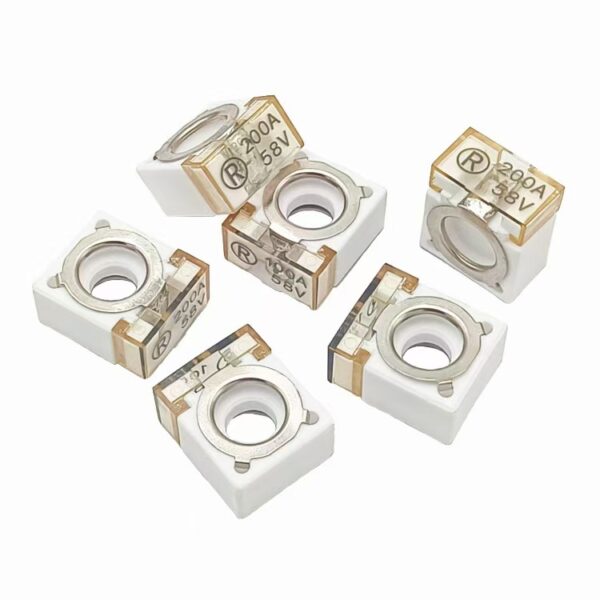



UL Certified Battery Terminal Fuse Block High Current ANL Fuse Holder Brass Stud Heat Resistant
UL Certified Battery Terminal Fuse Block High Current ANL Fuse Holder Brass Stud Heat Resistant
- Deskripsi
- Ulasan (0)
Deskripsi
What is a Battery Terminal Fuse Block?
A battery terminal fuse block is a specialized electrical component that combines a battery terminal connector with an integrated fuse holder. It mounts directly onto a battery post and provides both a secure connection to the battery and overcurrent protection for the electrical system. The battery terminal fuse block eliminates the need for separate fuse holders and additional wiring, creating a compact, space-saving solution that protects downstream circuits from short circuits and overloads.
The battery terminal fuse block is commonly used in automotive, marine, RV, and solar power systems where reliable battery connections and circuit protection are critical. By integrating the fuse directly at the battery source, the battery terminal fuse block ensures that the entire cable run from the battery is protected, significantly improving safety compared to unprotected or remotely fused connections.
Materials
The performance, durability, and conductivity of a battery terminal fuse block depend heavily on the quality of materials used in its construction.
| Component | Common Materials | Description |
|---|---|---|
| Terminal Post Connector | Lead, Brass, Copper, Zinc Alloy | Direct battery contact material; a high-quality battery terminal fuse block uses pure copper or brass for maximum conductivity |
| Conductor / Busbar | Brass, Tinned Copper, Copper | Internal current-carrying components; a premium battery terminal fuse block features tinned copper for corrosion resistance |
| Fuse Clips / Contacts | Brass, Phosphor Bronze, Tinned Copper | Fuse holding contacts; a reliable battery terminal fuse block uses spring-tempered materials for consistent fuse retention |
| Housing / Cover | PA66 (Nylon), ABS, PBT, Polycarbonate | Insulating body; a durable battery terminal fuse block uses UL94V-0 flame-retardant materials for safety |
| Hardware (Bolts, Nuts, Washers) | Steel, Stainless Steel, Brass | Mounting and cable attachment hardware; a corrosion-resistant battery terminal fuse block uses stainless steel or plated hardware |
| Seals / Gaskets | Silicone, EPDM Rubber | Weatherproofing components; a marine-grade battery terminal fuse block includes silicone seals for moisture protection |
Surface Treatment
Surface treatment plays a critical role in the corrosion resistance, conductivity, and longevity of a battery terminal fuse block.
| Surface Treatment | Application | Features |
|---|---|---|
| Tin Plating | Copper busbars, fuse clips, terminals | Excellent corrosion resistance, good solderability, cost-effective; a tinned model is ideal for marine and automotive use |
| Nickel Plating | Brass terminals, hardware | Hard surface, superior wear resistance, excellent corrosion protection; a nickel-plated model withstands harsh environments |
| Gold Plating | Signal fuse contacts | Highest conductivity, exceptional corrosion resistance; used in premium battery terminal fuse block models for critical applications |
| Zinc Plating | Steel hardware, bolts | Basic corrosion protection; a zinc-plated model offers good value for general applications |
| Anodizing | Aluminum components | Surface hardening, corrosion resistance; used in specialized battery terminal fuse block designs with aluminum components |
Specifications
A battery terminal fuse block is available in various configurations to match different electrical system requirements. Below are the key specifications:
| Specification Parameter | Typical Range | Description |
|---|---|---|
| Fuse Type Compatibility | ANL, AGU, MIDI, MAXI, ATC/ATO, Mini, MEGA | A versatile model supports multiple fuse types for different current ratings |
| Maximum Current Rating | 100A, 150A, 200A, 250A, 300A, 500A | The continuous current capacity of the battery terminal fuse block must exceed the system’s maximum load |
| Voltage Rating | 12V DC, 24V DC, 32V DC, 48V DC | Most models are designed for 12V to 48V DC systems |
| Number of Circuits | 1, 2, 3, 4, 6, 8 | A multi-circuit model can protect multiple accessories from a single battery connection |
| Terminal Type | Top Post, Side Post, Universal, Stud Mount | It is available for different battery terminal configurations |
| Wire Gauge (AWG) | 8 AWG to 4/0 AWG | A heavy-duty model accommodates large-gauge cables for high-current applications |
| Operating Temperature | -40°C to +105°C, -40°C to +125°C | A high-quality model maintains performance across extreme temperature ranges |
| Flammability Rating | UL94V-0, UL94V-2 | A safety-certified model meets fire resistance standards |
| Ingress Protection (IP) Rating | IP65, IP67 (for waterproof models) | A waterproof model provides protection against dust and water ingress |
Application Fields
The battery terminal fuse block is essential in any DC electrical system where battery overcurrent protection is required. Below are the primary application fields:
| Application Field | Specific Uses | Why Battery Terminal Fuse Block is Preferred |
|---|---|---|
| Automotive | Car audio systems, off-road lighting, winches, auxiliary lighting, emergency vehicles | It provides direct battery protection for high-power aftermarket accessories |
| Marine / Boating | Boat electrical systems, trolling motors, fish finders, navigation equipment, onboard chargers | A marine-grade model offers corrosion resistance essential for saltwater environments |
| Recreational Vehicles (RV) | House batteries, solar controllers, inverters, lighting circuits, slide-out motors | An RV model simplifies wiring and provides centralized protection for all house circuits |
| Commercial Trucks | Liftgates, auxiliary power units, refrigeration units, trailer connections | A heavy-duty model withstands vibration and high-current demands in commercial vehicles |
| Solar Power Systems | Battery banks, charge controllers, inverters, DC distribution panels | A solar model provides essential overcurrent protection between batteries and charge controllers |
| Industrial Equipment | Forklifts, aerial lifts, floor scrubbers, golf carts, utility vehicles | An industrial model ensures reliable power distribution in material handling equipment |
| Motorcycles & Powersports | ATVs, UTVs, snowmobiles, personal watercraft, motorcycles | A compact model fits in tight spaces while protecting essential electrical systems |
| Audio / Competition Systems | High-power car audio systems, competition vehicles | A high-current model handles thousands of watts while providing critical circuit protection |
Excellent Case: Battery Terminal Fuse Block in a Marine Vessel
Scenario:
A 45-foot offshore fishing boat named “Sea Hunter” underwent a complete electrical system upgrade. The vessel operates in saltwater environments and supports multiple high-current accessories including:
24V trolling motor (80A continuous)
Onboard battery charger (20A)
2000W inverter (170A peak)
LED navigation and deck lighting (15A)
Fish finder and GPS electronics (10A)
Electric downriggers (30A)
The boat has a three-battery bank system: two deep-cycle house batteries and one starting battery.
Why the Battery Terminal Fuse Block Was Selected:
Direct Battery Protection: Each battery was fitted with a battery terminal fuse block at the positive terminal. This ensured that every cable leaving the battery was protected immediately at the source, eliminating the risk of unprotected cable runs that could cause fires if damaged.
Corrosion Resistance: A marine-grade battery terminal fuse block with tinned copper conductors and stainless steel hardware was chosen specifically for its ability to withstand saltwater exposure. Traditional fuse holders had failed within months due to corrosion, but the battery terminal fuse block maintained clean connections throughout the season.
Space Optimization: The engine compartment has limited space. Using a battery terminal fuse block eliminated the need for separate distribution blocks and remote fuse holders, consolidating all protection directly at the battery terminals.
Simplified Troubleshooting: When a fault occurred, the battery terminal fuse block made it immediately visible which circuit had failed. The clear cover allowed technicians to inspect fuses without disconnecting anything, and the labeled circuits on the battery terminal fuse block simplified documentation.
Vibration Resistance: The vessel operates in rough offshore conditions. It featured a secure locking mechanism that prevented fuses from loosening due to vibration, a common failure point with traditional fuse holders.
Results Achieved:
| Metric | Before (Traditional Fuse Holders) | After (Battery Terminal Fuse Block) |
|---|---|---|
| Corrosion-Related Failures | 4-6 per season | 0 failures in 2 years |
| Wiring Length | 12 feet of unprotected cable per battery | 0 feet unprotected |
| Space Used | 3 separate components per battery | 1 integrated component per battery |
| Troubleshooting Time | 20-30 minutes per issue | 5 minutes per issue |
| Electrical Fire Risk | Moderate (unprotected cable runs) | Eliminated |
Conclusion:
The installation transformed the boat’s electrical reliability. The owner reported zero electrical failures during two full fishing seasons. The battery terminal fuse block not only provided superior protection but also simplified future system expansions. The local marine electrician now recommends a battery terminal fuse block as a standard upgrade for all vessel electrical systems, noting that the upfront cost is far less than the potential damage from an unfused battery cable short circuit.






Ulasan
Belum ada ulasan.