




Reliable Custom Precision Stainless Steel Ball Head Bolt with Partial Thread for Automotive

0 out of 5
Reliable Custom Precision Stainless Steel Ball Head Bolt with Partial Thread for Automotive
- Description
- Reviews (0)
Description
What Is a Ball Head Bolt?
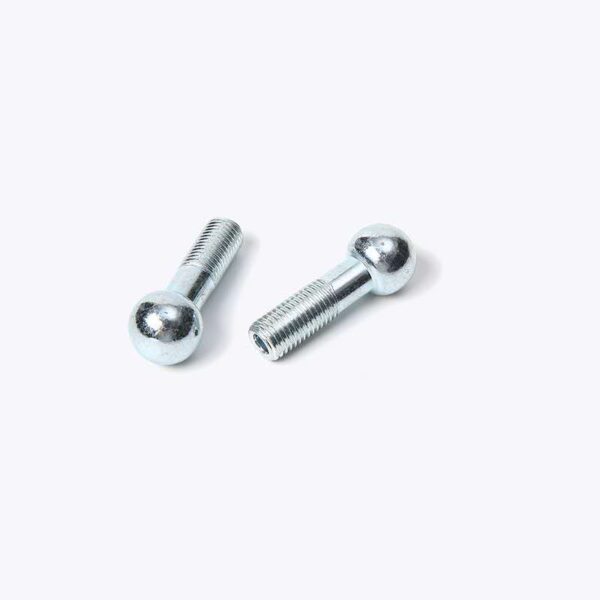
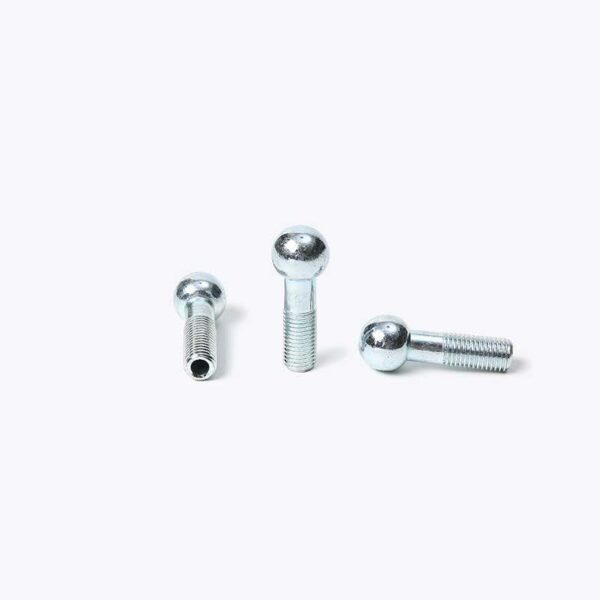
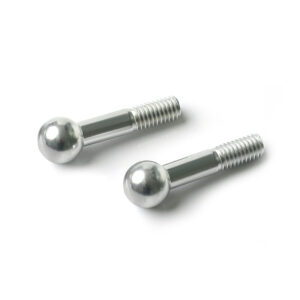
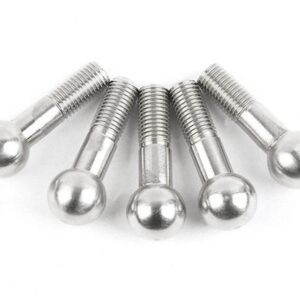
A Ball Head Bolt is a specialized type of fastener characterized by a spherical (ball-shaped) head instead of a traditional hexagonal or flat head. This unique design allows the bolt to act as a pivot point. When inserted into a mating socket or bearing housing, the spherical head can rotate and swivel, accommodating angular misalignment and enabling multi-directional movement within an assembly. They are fundamental components in mechanical linkages where flexibility and articulation are required.
Materials
The choice of material depends on the required strength, corrosion resistance, and operating environment.
Carbon Steel:
Low/Mild Steel: Used for general, light-duty applications where cost is the primary concern.
Medium/High Carbon Steel (e.g., C45): Offers higher strength for industrial machinery.
Alloy Steel (e.g., 4140, 4340): Heat-treated to achieve high tensile strength and wear resistance for critical applications like automotive and heavy equipment.
Stainless Steel:
Grades 304 & 316: The most common choices for their excellent corrosion resistance, making them ideal for marine, medical, and food processing equipment. Grade 316 offers superior resistance to chemicals and saltwater.
Other Materials:
Brass/Copper: Used for electrical conductivity or in decorative applications.
Aluminum: Specified for lightweight applications, such as in aerospace or racing components.
Plastics (e.g., Nylon, POM): Used in light-duty, low-friction, or non-conductive applications.
Surface Treatment
Surface treatments are applied primarily to improve corrosion resistance and reduce friction for smoother movement.
Zinc Plating: A cost-effective, standard finish for carbon steel bolts used indoors or in dry environments.
Zinc-Nickel / Zinc-Flake (e.g., Geomet, Dacromet): Provides a higher level of corrosion protection, often used in automotive under-hood and suspension components.
Hot-Dip Galvanizing (HDG): A thick, durable coating for large bolts used in outdoor structures like construction equipment and transmission towers.
Chrome Plating: Used for both wear resistance and a high-polish aesthetic, common in custom automotive and motorcycle parts.
Passivation: A chemical process used on stainless steel to remove free iron and enhance its natural corrosion-resistant oxide layer.
Black Oxide: A thin coating that provides mild corrosion resistance and a dark, non-reflective finish, often used in tools and precision optics.
Specifications
Ball head bolts are defined by several key dimensional and performance specifications.
Thread Sizes: Available in a wide range of metric (e.g., M4, M5, M6, M8, M10, M12) and imperial (e.g., 1/4-20, 5/16-18, 3/8-16) sizes.
Ball Diameter Tolerance: The precision of the sphere is critical. High-quality bolts maintain tight tolerances (e.g., h7 or h9) to ensure smooth operation within a bearing without excessive play.
Length & Thread Length: Defined by the distance from the bottom of the ball to the end of the bolt, as well as the length of the threaded portion.
Strength Grades: For steel bolts, grades such as 8.8, 10.9, or 12.9 indicate the tensile strength of the fastener.
Standards: While many are proprietary, some are designed to fit standard spherical bearing housings or rod ends conforming to DIN ISO 12240 (formerly DIN 648).
Application Areas
The ability to transmit motion while accommodating misalignment makes them essential in many industries.
Automotive: This is the most common application. They are the core component of ball joints in suspension systems (control arms) and steering linkages (tie-rod ends).
Industrial Machinery: Used in push-pull control linkages, lever mechanisms, and as pivots for guarding and covers.
Robotics & Automation: Employed in articulated joints for robotic arms, camera mounts, and precision alignment fixtures.
Aerospace: Found in flight control systems and landing gear mechanisms where reliability and zero-failure tolerances are paramount.
Marine Rigging: Used in sailboat control systems and steering mechanisms where corrosion resistance is vital.
Furniture & Fixtures: Used in adjustable feet for heavy equipment or as pivot points in reclining chairs.
An Excellent Case: Heavy-Duty Construction Equipment Linkage
The Scenario: Consider the steering system of a large articulated dump truck or a front-end loader. The hydraulic cylinder must push and pull the wheel assembly to steer the vehicle. However, the steering components move in an arc, not a straight line. If a standard bolt were used to connect the hydraulic cylinder to the steering arm, the rigid connection would bind and fail under the immense stress as the angle of the connection changes.
The Solution: A high-strength ball head bolt (often called a “spherical rod end bolt” in this context) is used to connect the hydraulic cylinder’s rod end to the steering arm. The bolt’s spherical head sits inside a lubricated spherical bearing. The bearing’s outer housing is mounted to the steering arm, while the bolt’s threaded shaft is secured to the hydraulic cylinder.
Why It Excels:
Accommodates Complex Motion: As the hydraulic cylinder extends and retracts, the steering arm moves through an arc. The spherical head of the bolt swivels within the bearing, allowing the connection point to change angle dynamically without inducing any bending stress on the hydraulic cylinder rod.
Withstands Extreme Loads: Made from heat-treated alloy steel (grade 12.9) with a zinc-nickel coating, this ball head bolt can handle the multi-ton forces, shock loads, and abrasive dirt encountered in a construction site environment.
Ensures Smooth Operation: The precision-ground spherical surface and the lubricated bearing ensure that the steering movement is smooth, precise, and free of “stiction” (static friction), giving the operator full control of the massive vehicle. Without this simple but sophisticated bolt, the complex, articulated movement required for modern construction machinery would be impossible.


Reviews
There are no reviews yet.