


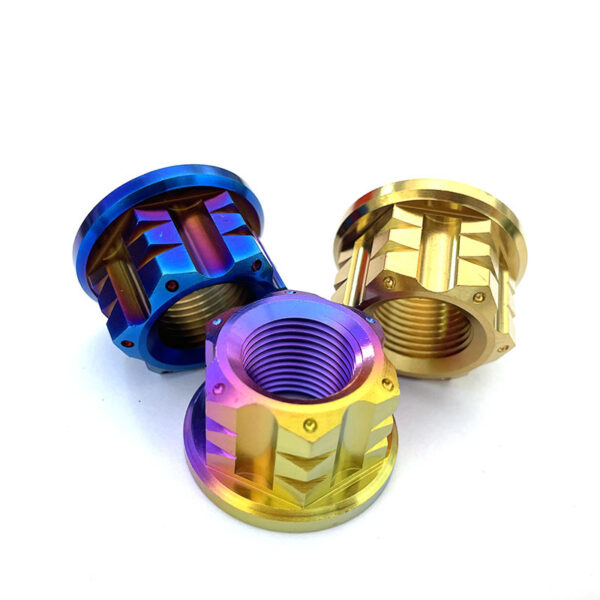
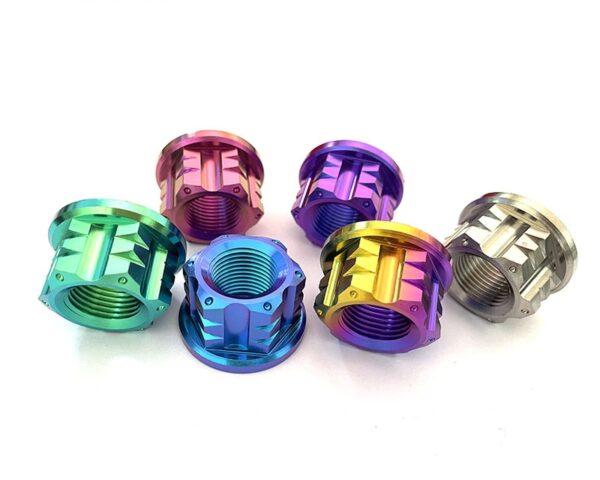
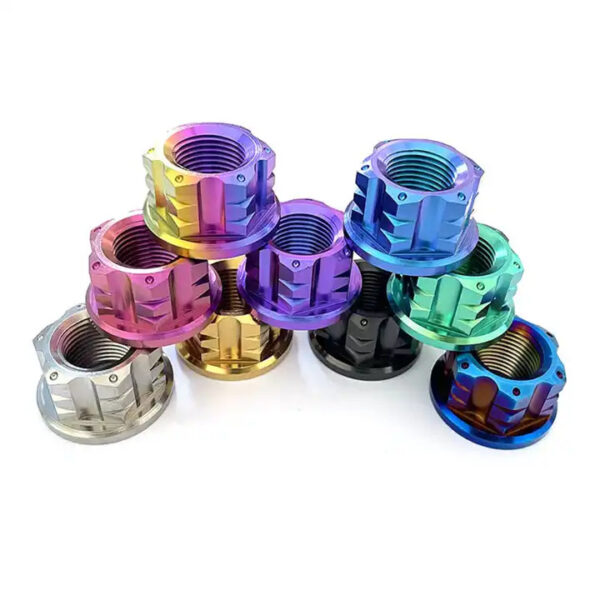
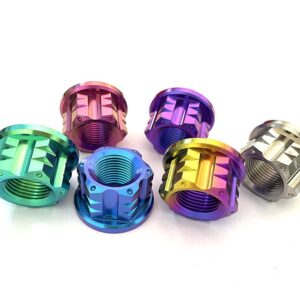
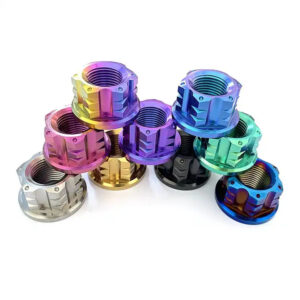
Reliable Gr5 Titanium Alloy Axle Nut Anodized for Retrofit Electric Motorcycle

Reliable Gr5 Titanium Alloy Axle Nut Anodized for Retrofit Electric Motorcycle
- Beschreibung
- Bewertungen (0)
Beschreibung
What Is An Axle Nut?
An axle nut is a critical, high-strength fastener specifically designed to secure a vehicle’s wheel hub and bearing assembly onto its axle shaft. It applies a precise clamping force that holds all rotating components (wheel, brake rotor, hub, and bearing) in place, ensuring proper wheel alignment, bearing preload, and safe operation. Axle nuts are often larger and torqued to higher specifications than standard lug nuts, and many feature integrated locking mechanisms (such as a crown with staked tabs, a nylon insert, or a cotter pin hole) to prevent loosening from vibration and rotational forces.
Materials
Axle nuts are manufactured from high-strength materials to withstand extreme shear and clamping forces. Common materials include:
Medium Carbon Steel (Grade 5 or equivalent): A common, cost-effective choice for many passenger vehicles, offering good strength.
Medium Carbon Alloy Steel (Grade 8, SAE 4140/4340): Heat-treated to provide very high tensile strength and durability, used in performance and heavy-duty applications.
Stainless Steel (304 or 316): Used in marine or corrosive environments for its excellent corrosion resistance, though strength grades vary.
Titanium Alloys (e.g., Grade 5 Ti-6Al-4V): Used in high-performance racing and aerospace for an exceptional strength-to-weight ratio, but at a higher cost.
Surface Treatments
Surface treatments are applied to prevent corrosion, reduce friction during installation, and sometimes indicate torque status.
Zinc Plating (Yellow or Clear): The most common finish, providing good corrosion resistance and a consistent friction coefficient for accurate torque application.
Phosphate and Oil Coating: Offers corrosion protection and acts as a break-in lubricant.
Black Oxide: Provides a mild corrosion resistance and a dark, non-reflective finish.
Geometric Locking Feature: This is not a coating but a design aspect; the nut’s crown is often designed to be deformed (staked) into a groove on the axle after final torque is applied, creating a permanent mechanical lock.
Specifications
Axle nuts are defined by precise mechanical and dimensional specifications:
Thread Size and Pitch: Must precisely match the axle shaft’s threads (e.g., M20 x 1.5, M24 x 1.5, or 3/4″-16, 1″-20 in imperial).
Hex Size: The wrench size required (e.g., 30mm, 32mm, 36mm).
Torque Specification: A critical value, often very high (e.g., 180-350 Nm or 130-260 ft-lbs), and sometimes followed by a specific angle-tightening procedure.
Locking Mechanism Type: Defined as a staking-style (crown nut), a castellated nut (for a cotter pin), a nylon-insert lock nut, or a two-piece jam nut system.
Flange Design: Many feature an integrated wide flange to distribute clamping load evenly across the bearing.
Application Fields
The primary application is in the automotive and transportation sectors, wherever a wheel rotates on an axle:
Passenger Cars and Light Trucks: To secure front-wheel-drive hub assemblies and rear axle bearings.
Heavy-Duty Trucks and Commercial Vehicles: Larger and higher-strength nuts for severe service conditions.
Performance and Racing Vehicles: Often use lightweight or specially designed nuts that can withstand extreme forces and frequent removal.
Motorcycles and ATVs: To secure both front and rear wheels.
Trailers (Utility and Recreational): To secure the hub and bearing assembly on trailer axles.
Industrial and Agricultural Machinery: In wheel assemblies for forklifts, tractors, and other mobile equipment.

Bewertungen
Es gibt noch keine Bewertungen.